Which of the Following Is Not an Art Movement From the Early 20th Century
| Millennium: | second millennium |
|---|---|
| Centuries: |
|
| Timelines: |
|
| State leaders: |
|
| Decades: |
|
| Categories: | Births – Deaths Establishments – Disestablishments |

The 20th (twentieth) century began on January 1, 1901 (MCMI), and ended on December 31, 2000 (MM).[1] The 20th century was dominated by significant events that divers the modern era: Spanish flu pandemic, World War I and Earth State of war II, nuclear weapons, nuclear power and space exploration, nationalism and decolonization, technological advances, and the Cold War and post-Cold War conflicts. These reshaped the political and social structure of the globe.
The 20th century saw a massive transformation of humanity's relationship with the natural world. Global population, sea level rising, and ecological collapses increased while contest for country and dwindling resources accelerated deforestation, water depletion, and the mass extinction of many of the globe'southward species and decline in the population of others. Man-made global warming increased the adventure of extreme conditions conditions.
Additional themes include intergovernmental organizations and cultural homogenization through developments in emerging transportation and communications applied science; poverty reduction and world population growth, awareness of ecology degradation, ecological extinction;[2] [3] and the nascence of the Digital Revolution. Automobiles, airplanes and the use of home appliances became common, equally did video and audio recording. Keen advances in ability generation, communication, and medical engineering immune for near-instantaneous worldwide estimator communication and genetic modification of life.
The repercussions of the World Wars, Cold State of war, and globalization crafted a world where people are more than united than whatever previous fourth dimension in human history, equally exemplified by the institution of international law, international aid, and the United nations. The Marshall Plan—which spent $13 billion ($110 billion in 2020 U.South. dollars)[4] to rebuild the economies of post-war nations—launched "Pax Americana". Throughout the latter half of the 20th century, the rivalry between the United States and the Soviet Spousal relationship created enormous tensions around the globe which manifested in various armed proxy regional conflicts and the omnipresent danger of nuclear proliferation. The dissolution of the Soviet Union in 1991 afterwards the plummet of its European alliance was heralded by the West as the end of communism, though by the century's end roughly i in six people on Earth lived under communist rule, generally in China which was rapidly ascent as an economic and geopolitical power.
It took over two hundred thou years of modernistic human history and 6 meg years of homo evolution for the world's population to accomplish ane billion in 1804;[five] world population reached an estimated 2 billion in 1927; by late 1999, the global population reached 6 billion, with over half in East, South and Southeast Asia.[vi] [7] [viii] Global literacy averaged 80%. Penicillin and other medical breakthroughs combined with the World Health Organisation'due south global vaccination campaigns to eradicate smallpox and other diseases responsible for more than man deaths than all wars and natural disasters combined yielded unprecedented results; smallpox at present simply existed in labs.[ix] [10] Machines came to be used in all areas of production, feeding increasingly intricate supply chains that allowed flesh for the commencement fourth dimension to exist constrained not past how much it could produce, simply by peoples' willingness to swallow. Trade improvements greatly expanded upon the limited set up of food-producing techniques used since the Neolithic period, multiplying the multifariousness of foods available and boosting the quality of human nutrition. Until the early on 19th century, life expectancy from birth was about thirty in most populations; global lifespan-averages exceeded 40 years for the outset time in history, with over half achieving 70 or more than years (three decades longer than a century before).[11]
Overview [edit]

The 20th (twentieth) century began on Jan i, 1901,[ane] and concluded on Dec 31, 2000.[12] It was the 10th and last century of the second millennium. Different virtually century years, the year 2000 was a leap year, and the 2nd century leap year in the Gregorian agenda after 1600.
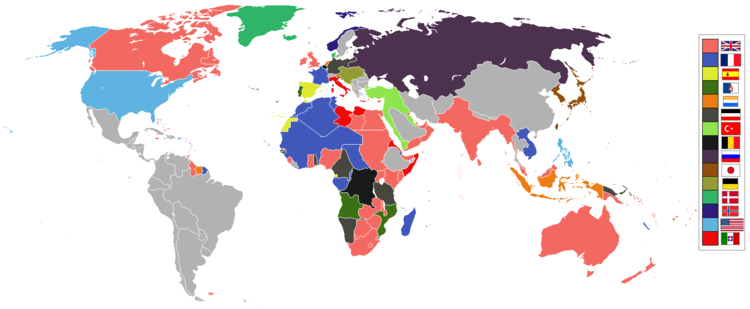
The century had the first global-scale total wars between world powers across continents and oceans in Globe State of war I and Globe War II. Nationalism became a major political issue in the world in the 20th century, acknowledged in international police along with the right of nations to self-determination, official decolonization in the mid-century, and related regional conflicts.
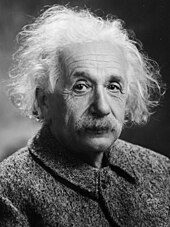
The century saw a major shift in the mode that many people lived, with changes in politics, ideology, economic science, society, culture, science, technology, and medicine. The 20th century may have seen more than technological and scientific progress than all the other centuries combined since the dawn of civilization. Terms similar nationalism, globalism, environmentalism, ideology, globe war, genocide, and nuclear state of war entered common usage. Scientific discoveries, such equally the theory of relativity and quantum physics, profoundly changed the foundational models of physical science, forcing scientists to realize that the universe was more complex than previously believed, and dashing the hopes (or fears) at the end of the 19th century that the last few details of scientific knowledge were virtually to be filled in. It was a century that started with horses, simple automobiles, and freighters but concluded with high-speed rail, cruise ships, global commercial air travel and the Space Shuttle. Horses and other pack animals, every club'southward basic class of personal transportation for thousands of years, were replaced by automobiles and buses within a few decades. These developments were made possible by the exploitation of fossil fuel resource, which offered energy in an easily portable course, merely also caused concern about pollution and long-term bear upon on the surround. Humans explored space for the get-go time, taking their get-go footsteps on the Moon.
Mass media, telecommunications, and information engineering (specially computers, paperback books, public teaching, and the Net) fabricated the world'southward cognition more widely available. Advancements in medical engineering science besides improved the health of many people: the global life expectancy increased from 35 years to 65 years. Rapid technological advancements, however, also immune warfare to reach unprecedented levels of devastation. World State of war Two alone killed over 60 million people, while nuclear weapons gave humankind the ways to demolish itself in a brusque fourth dimension. However, these same wars resulted in the devastation of the royal organization. For the first time in human history, empires and their wars of expansion and colonization ceased to be a cistron in international affairs, resulting in a far more than globalized and cooperative earth. The last time major powers clashed openly was in 1945, and since then, violence has seen an unprecedented decline.[thirteen]
The world too became more culturally homogenized than ever with developments in transportation and communications engineering science, pop music and other influences of Western culture, international corporations, and what was arguably a truly global economy by the end of the 20th century.
Summary [edit]
Technological advancements during World War I changed the manner war was fought, equally new inventions such every bit tanks, chemic weapons, and aircraft modified tactics and strategy. Subsequently more than 4 years of trench warfare in Western Europe, and up to 22 million dead, the powers that had formed the Triple Entente (France, United kingdom, and Russia, later replaced by the United States and joined past Italian republic and Romania) emerged victorious over the Cardinal Powers (Frg, Austro-hungarian empire, the Ottoman Empire and Republic of bulgaria). In addition to annexing many of the colonial possessions of the vanquished states, the Triple Entente exacted punitive restitution payments from them, plunging Germany in particular into economic depression. The Austro-Hungarian and Ottoman empires were dismantled at the war's decision. The Russian Revolution resulted in the overthrow of the Tsarist government of Nicholas II and the onset of the Russian Civil War. The victorious Bolsheviks then established the Soviet Matrimony, the world's first communist state.
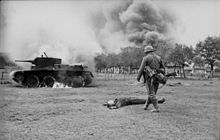
At the beginning of the period, the British Empire was the world's well-nigh powerful nation,[15] having acted as the world's policeman for the past century. Fascism, a movement which grew out of post-war malaise and which accelerated during the Great Depression of the 1930s, gained momentum in Italia, Deutschland, and Spain in the 1920s and 1930s, culminating in World War II, sparked by Nazi Germany's aggressive expansion at the expense of its neighbors. Meanwhile, Japan had quickly transformed itself into a technologically advanced industrial power and, forth with Germany and Italy, formed the Axis powers. Japan'southward armed services expansionism in East Asia and the Pacific Ocean brought information technology into conflict with the United States, culminating in a surprise attack which drew the US into Globe War Ii. After some years of dramatic military success, Germany was defeated in 1945, having been invaded by the Soviet Marriage and Poland from the East and by the United States, the United Kingdom, Canada, and France from the W. After the victory of the Allies in Europe, the war in Asia ended with the Soviet invasion of Manchuria and the dropping of ii atomic bombs on Japan by the US, the first nation to develop nuclear weapons and the only one to use them in warfare. In total, Globe War II left some 60 one thousand thousand people dead. After the state of war, Germany was occupied and divided between the Western powers and the Soviet Union. Eastward Federal republic of germany and the rest of Eastern Europe became Soviet puppet states under communist rule. Western Europe was rebuilt with the aid of the American Marshall Program, resulting in a major post-war economic smash, and many of the affected nations became close allies of the Us.
With the Axis defeated and Britain and French republic rebuilding, the United States and the Soviet Spousal relationship were left standing every bit the world's merely superpowers. Allies during the war, they soon became hostile to one another as their competing ideologies of communism and democratic capitalism proliferated in Europe, which became divided by the Iron Curtain and the Berlin Wall. They formed competing military alliances (NATO and the Warsaw Pact) which engaged in a decades-long standoff known as the Common cold War. The menstruation was marked by a new arms race as the USSR became the 2nd nation to develop nuclear weapons, which were produced by both sides in sufficient numbers to end most human life on the planet had a large-scale nuclear exchange ever occurred. Mutually assured destruction is credited by many historians as having prevented such an exchange, each side being unable to strike first at the other without ensuring an equally devastating retaliatory strike. Unable to appoint ane another direct, the conflict played out in a series of proxy wars around the world—especially in China, Korea, Republic of cuba, Vietnam, and Afghanistan—equally the USSR sought to consign communism while the US attempted to contain it. The technological competition betwixt the two sides led to substantial investment in research and evolution which produced innovations that reached far beyond the battlefield, such as space exploration and the Net.
In the latter half of the century, well-nigh of the European-colonized world in Africa and Asia gained independence in a process of decolonization. Meanwhile, globalization opened the door for several nations to exert a strong influence over many world diplomacy. The US's global military presence spread American civilisation around the world with the appearance of the Hollywood motion moving-picture show industry, Broadway, rock and roll, pop music, fast food, big-box stores, and the hip-hop lifestyle. Britain also connected to influence globe civilisation, including the "British Invasion" into American music, leading many rock bands from other countries (such as Swedish ABBA) to sing in English. After the Soviet Matrimony complanate under internal force per unit area in 1991, virtually of the communist governments information technology had supported around the world were dismantled—with the notable exceptions of China, North korea, Republic of cuba, Vietnam, and Laos—followed past awkward transitions into market economies.
Following Globe War Two, the Un, successor to the League of Nations, was established as an international forum in which the earth's nations could talk over issues diplomatically. It enacted resolutions on such topics equally the conduct of warfare, environmental protection, international sovereignty, and human being rights. Peacekeeping forces consisting of troops provided by diverse countries, with diverse United nations and other help agencies, helped to save famine, disease, and poverty, and to suppress some local armed conflicts. Europe slowly united, economically and, in some ways, politically, to form the European Union, which consisted of 15 European countries past the end of the 20th century.
Nature of innovation and change [edit]
Due to continuing industrialization and expanding merchandise, many significant changes of the century were, directly or indirectly, economic and technological in nature. Inventions such as the lite seedling, the automobile, and the telephone in the late 19th century, followed by supertankers, airliners, motorways, radio, television, antibiotics, nuclear power, frozen food, computers and microcomputers, the Internet, and mobile telephones affected people's quality of life across the adult world. Scientific enquiry, engineering professionalization and technological development—much of information technology motivated by the Cold War artillery race—drove changes in everyday life.
[edit]
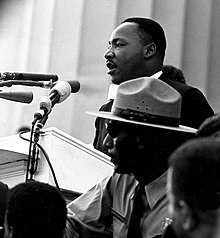
At the beginning of the century, stiff bigotry based on race and sex was pregnant in nigh societies. Although the Atlantic slave trade had ended in the 19th century, movements for equality for non-white people in the white-dominated societies of North America, Europe, and South Africa continued. By the end of the 20th century, in many parts of the world, women had the same legal rights as men, and racism had come to exist seen as unacceptable, ofttimes backed upward by legislation.[16] Attitudes towards homosexuality also began to change in the subsequently role of the century. When the Republic of Republic of india was constituted, the disadvantaged classes of the caste system in India became entitled to affirmative action benefits in instruction, employment and government.[17] [xviii]
World at the end of the 20th century [edit]
Communications and information technology, transportation engineering, and medical advances had radically altered daily lives. Europe appeared to be at a sustainable peace for the outset fourth dimension in recorded history. The people of the Indian subcontinent, a sixth of the earth population at the end of the 20th century, had attained an indigenous independence for the first fourth dimension in centuries. Cathay, an aboriginal nation comprising a fifth of the earth population, was finally open to the world, creating a new state after the about-complete destruction of the old cultural society. With the end of colonialism and the Cold War, almost a billion people in Africa were left in new nation states later on centuries of foreign domination.
The world was undergoing its second major catamenia of globalization; the first, which started in the 18th century, having been terminated by World War I. Since the Us was in a ascendant position, a major part of the process was Americanization. The influence of China and India was besides rising, as the globe's largest populations were apace integrating with the globe economy.
Terrorism, dictatorship, and the spread of nuclear weapons were pressing global issues. The earth was still blighted by pocket-size wars and other violent conflicts, fueled by competition over resource and by ethnic conflicts.
Affliction threatened to destabilize many regions of the world. New viruses such as the Due west Nile virus continued to spread. Malaria and other diseases afflicted large populations. Millions were infected with HIV, the virus which causes AIDS. The virus was becoming an epidemic in southern Africa.
Based on research done by climate scientists, the majority of the scientific community consider that in the long term environmental issues may threaten the planet'south habitability.[19] One argument is that of global warming occurring due to human-caused emission of greenhouse gases, particularly carbon dioxide produced by the burning of fossil fuels.[20] This prompted many nations to negotiate and sign the Kyoto treaty, which set mandatory limits on carbon dioxide emissions.
World population increased from most 1.6 billion people in 1901 to six.1 billion at the century'due south terminate.[21] [22]
Wars and politics [edit]

Map of territorial changes in Europe after World War I (every bit of 1923).
The number of people killed during the century past government actions was in the hundreds of millions. This includes deaths caused past wars, genocide, politicide and mass murders. The deaths from acts of state of war during the two earth wars alone have been estimated at between fifty and 80 million.[ commendation needed ] Political scientist Rudolph Rummel estimated 262,000,000 deaths caused by democide, which excludes those killed in war battles, civilians unintentionally killed in state of war and killings of rioting mobs.[23] According to Charles Tilly, "Altogether, near 100 million people died as a direct upshot of action past organized armed forces units backed by one government or some other over the course of the century. Most likely a comparable number of civilians died of state of war-induced disease and other indirect effects."[24] Information technology is estimated that approximately 70 million Europeans died through war, violence and famine betwixt 1914 and 1945.[25]
- The Armenian, Syriac and Greek genocide were the systematic destruction, mass murder and expulsion of the Armenians, Assyrians and Greeks in the Ottoman Empire during World War I, spearheaded past the ruling Committee of Union and Progress (CUP).[26] [27]
- Ascent nationalism and increasing national awareness were among the many causes of World War I (1914–1918), the start of two wars to involve many major world powers including Frg, France, Italy, Nippon, Russian federation/USSR, the British Empire and the United States. World War I led to the creation of many new countries, peculiarly in Eastern Europe. At the time, it was said by many to be the "war to end all wars".
- Afterwards gaining political rights in the United States and much of Europe in the first role of the century, and with the advent of new birth control techniques, women became more independent throughout the century.
- Industrial warfare profoundly increased in its scale and complexity during the first half of the 20th century. Notable developments included chemical warfare, the introduction of military aviation and the widespread use of submarines. The introduction of nuclear warfare in the mid-20th century marked the definite transition to modern warfare.
- Civil wars occurred in many nations. A tearing civil war broke out in Spain in 1936 when General Francisco Franco rebelled against the Second Castilian Republic. Many[28] consider this war equally a testing battleground for World War Ii, as the fascist armies bombed some Spanish territories.
- The Great Depression in the 1930s led to the rise of Fascism and Nazism in Europe.
- Globe War Two (1939–1945) involved Eastern asia and the Pacific, in the form of Japanese aggression against China and the United States. Civilians also suffered profoundly in Earth War II, due to the aerial bombing of cities on both sides, and the German genocide of the Jews and others, known every bit the Holocaust.
- During Globe State of war I, in the Russian Revolution of 1917, 300 years of Romanov reign were concluded and the Bolsheviks, under the leadership of Vladimir Lenin, established the world's first Communist state. Later on the Soviet Matrimony's involvement in World War Ii, communism became a major forcefulness in global politics, notably in Eastern Europe, Cathay, Indochina and Cuba, where communist parties gained virtually-absolute ability.

- The Cold War (1947–1989) caused an arms race and increasing competition between the ii major players in the world: the Soviet Union and the United States. This contest included the development and improvement of nuclear weapons and the Space Race. This led to the proxy wars with the Western bloc, including wars in Korea (1950–1953) and Vietnam (1957–1975).
- The Soviet authorities caused the deaths of millions of their own citizens in guild to eliminate domestic opposition.[29] More than 18 million people passed through the Gulag, with a further 6 meg being exiled to remote areas of the Soviet Union.[xxx]
- The civil rights move in the U.s.a. and the movement confronting apartheid in S Africa challenged racial segregation in those countries.
- The two world wars led to efforts to increment international cooperation, notably through the founding of the League of Nations subsequently World State of war I, and its successor, the Un, after World State of war 2.
- Nationalist movements in the subcontinent led to the independence and segmentation of Jawaharlal Nehru-led India and Muhammad Ali Jinnah-led Pakistan.
- Mahatma Gandhi'south nonviolence and Indian independence motion against the British Empire influenced many political movements around the globe, including the civil rights move in the U.S., and freedom movements in South Africa and Burma.
- The creation of Israel in 1948, a Jewish state in the Middle Due east, at the end of the British Mandate for Palestine, fueled many regional conflicts. These were likewise influenced by the vast oil fields in many of the other countries of the predominantly Arab region.
- The cease of colonialism led to the independence of many African and Asian countries. During the Common cold War, many of these aligned with the The states, the USSR, or Mainland china for defense.

- After a long period of ceremonious wars and conflicts with western powers, China'southward last regal dynasty ended in 1912. The resulting republic was replaced, after another civil state of war, by a communist People's Republic in 1949. At the end of the 20th century, though still ruled by a communist political party, Cathay'southward economical organization had largely transformed to commercialism.
- The Smashing Chinese Famine was a direct cause of the expiry of tens of millions of Chinese peasants between 1959 and 1962. It is thought to exist the largest famine in human being history.[31]
- The Vietnam State of war acquired two million deaths, changed the dynamics between the Eastern and Western Blocs, and contradistinct Due north-South relations.[32]
- The Soviet War in Transitional islamic state of afghanistan caused one million deaths and contributed to the downfall of the Soviet Union.[31]
- The revolutions of 1989 released Eastern and Central Europe from Soviet supremacy. Soon thereafter, the Soviet Spousal relationship, Czechoslovakia, and Yugoslavia dissolved, the latter violently over several years, into successor states, many rife with indigenous nationalism. Meanwhile, East Germany and West Germany were reunified in 1990.
- The Tiananmen Square protests of 1989, culminating in the deaths of hundreds of civilian protesters, were a series of demonstrations in and near Tiananmen Square in Beijing, Cathay. Led mainly by students and intellectuals, the protests occurred in a year that saw the collapse of a number of communist governments effectually the world.
- European integration began in earnest in the 1950s, and somewhen led to the European Union, a political and economical wedlock that comprised fifteen countries at the cease of the 20th century.
Civilization and entertainment [edit]
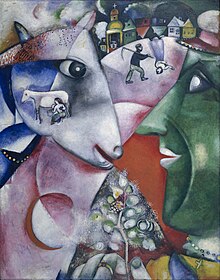
- Every bit the century began, Paris was the artistic capital of the world, where both French and foreign writers, composers and visual artists gathered. By the end of the century New York Metropolis had become the artistic capital of the globe.
- Theater, films, music and the media had a major influence on fashion and trends in all aspects of life. As many films and much music originate from the United states, American culture spread rapidly over the world.
- 1953 saw the coronation of Queen Elizabeth 2, an iconic figure of the century.
- Visual culture became more dominant not just in films but in comics and television as well. During the century a new skilled understanding of narrativist imagery was developed.
- Computer games and internet surfing became new and popular form of entertainment during the last 25 years of the century.
- In literature, science fiction, fantasy (with well-developed fictional worlds, rich in detail), and alternative history fiction gained unprecedented popularity. Detective fiction gained unprecedented popularity in the interwar period. In the United States in 1961 Grove Press published Tropic of Cancer a novel by Henry Miller redefining pornography and censorship in publishing in America.
Music [edit]

The invention of music recording technologies such as the phonograph tape, and dissemination technologies such as radio dissemination, massively expanded the audition for music. Prior to the 20th century, music was generally only experienced in live performances. Many new genres of music were established during the 20th century.
- Igor Stravinsky revolutionized classical composition.
- In the 1920s, Arnold Schoenberg adult the twelve-tone technique, which became widely influential on 20th-century composers.
- In classical music, composition branched out into many completely new domains, including dodecaphony, aleatoric (chance) music, and minimalism.
- Tango was created in Argentina and became extremely popular in the rest of the Americas and Europe.
- Blues and jazz music became popularized during the 1910s, 1920s and 1930s in the United States.
- Country music develops in the 1920s and 1930s in the United States.
- Dejection and country went on to influence rock and roll in the 1950s, which along with folk music, increased in popularity with the British Invasion of the mid-to-late 1960s.
- Rock soon branched into many dissimilar genres, including folk stone, heavy metallic, punk rock, and alternative rock and became the dominant genre of popular music.
- This was challenged with the rise of hip hop in the 1980s and 1990s.
- Other genres such as house, techno, reggae, and soul all developed during the latter half of the century and went through diverse periods of popularity.
- Synthesizers began to be employed widely in music and crossed over into the mainstream with new wave music in the 1980s. Electronic instruments have been widely deployed in all manners of pop music and has led to the development of such genres as house, synth-pop, electronic dance music, and industrial.
Moving-picture show, idiot box and theatre [edit]

Picture equally an artistic medium was created in the 20th century. The commencement modern moving-picture show theatre was established in Pittsburgh in 1905.[33] Hollywood developed equally the center of American flick production. While the beginning films were in black and white, technicolor was developed in the 1920s to allow for color films. Sound films were developed, with the first total-length feature picture, The Jazz Vocalist, released in 1927. The Academy Awards were established in 1929. Animation was besides developed in the 1920s, with the beginning full-length cel blithe characteristic film Snowfall White and the Vii Dwarfs, released in 1937. Computer-generated imagery was developed in the 1980s, with the outset total-length CGI-blithe film Toy Story was released in 1995.
- Julie Andrews, Harry Belafonte, Humphrey Bogart, Marlon Brando, James Cagney, Charlie Chaplin, Sean Connery, Tom Cruise, James Dean, Robert De Niro, Harrison Ford, Clark Gable, Cary Grant, Audrey Hepburn, Katharine Hepburn, Bruce Lee, Marilyn Monroe, Paul Newman, Jack Nicholson, Al Pacino, Sidney Poitier, Meryl Streep, Elizabeth Taylor, James Stewart, and John Wayne are among the most popular Hollywood stars of the 20th century.
- Madhubala, Jean-Paul Belmondo, Karel Roden, Sean Connery, Marcello Mastroianni, Salah Zulfikar, Marlene Dietrich, Brigitte Bardot, Omar Sharif, Catherine Deneuve, Alain Delon, Soad Hosny, Fernanda Montenegro, Sophie Marceau, Fatima Rushdi, Amitabh Bachchan, Jean Gabin, Toshiro Mifune, Lars Mikkelsen, Sophia Loren, Youssef Wahbi, Claudia Cardinale, Klaus Kinski, Gérard Depardieu, Max Von Sydow, Faten Hamama, Rutger Hauer and Toni Servillo are amongst the nigh popular movie stars of the 20th century.
- Sergei Eisenstein, D. W. Griffith, Cecil B. DeMille, Frank Capra, Howard Hawks, John Ford, Orson Welles, Martin Scorsese, John Huston, Alfred Hitchcock, Akira Kurosawa, Spike Lee, Ingmar Bergman, Federico Fellini, Walt Disney, Stanley Kubrick, Steven Spielberg, Ridley Scott, Woody Allen, Quentin Tarantino, James Cameron, William Friedkin, Ezz El-Dine Zulficar and George Lucas are amid the near important and pop filmmakers of the 20th century.
- In theater, sometimes referred to equally Broadway in New York City, playwrights such as Eugene O'Neill, Samuel Beckett, Edward Albee, Arthur Miller and Tennessee Williams introduced innovative linguistic communication and ideas to the idiom. In musical theater, figures such every bit Rodgers and Hammerstein, Lerner and Loewe, and Irving Berlin had an enormous impact on both film and the civilisation in general.
- Modern Dance is born in America equally both a 'rebellion' against centuries-old European ballet, as well as built-in from the oppression in America. Dancers and choreographers Alvin Ailey, Isadora Duncan, Vaslav Nijinsky, Ruth St. Denis, Mahmoud Reda, Martha Graham, José Limón, Doris Humphrey, Merce Cunningham, and Paul Taylor re-defined move, struggling to bring it back to its 'natural' roots and along with Jazz, created a solely American art form. Alvin Ailey is credited with popularizing modern dance and revolutionizing African-American participation in 20th-century concert dance. His company gained the nickname "Cultural Administrator to the World" because of its extensive international touring. Ailey's choreographic masterpiece Revelations is believed to be the best known and most often seen modern dance functioning.
Video games [edit]

Video games—due to the great technological steps forward in computing since the second post-war period—are the new form of entertainment emerged in the 20th century alongside films.
- While already conceptualized in the 1940s–50s, video games only emerged as an industry during the 1970s, and then exploded into social and cultural phenomenon such equally the golden age of arcade video games, with notable releases such as Taito's Space Invaders, Atari's Asteroids, and Namco's Pac-Man,[34] the worldwide success of Nintendo's Super Mario Bros. [35] and the release in the 1990s of Sony PlayStation console, the first one to intermission the record of 100 million units sold.[36]
- Video game design becomes a subject area and a job. Some game designers in this century stand out for their piece of work, as Shigeru Miyamoto, Hideo Kojima, Sid Meier and Will Wright.
Art and architecture [edit]

- The art earth experienced the development of new styles and explorations such as fauvism, expressionism, Dadaism, cubism, de stijl, surrealism, abstract expressionism, color field, pop art, minimal art, lyrical abstraction, and conceptual art.
- The mod art movement revolutionized art and civilisation and set the phase for both Modernism and its analogue postmodern art as well every bit other contemporary art practices.
- Art Nouveau began as advanced compages and pattern but cruel out of fashion after World War I. The style was dynamic and inventive merely unsuited to the depression of the Great State of war.
- In Europe, modern architecture departed from the decorated styles of the Victorian era. Streamlined forms inspired by machines became commonplace, enabled by developments in building materials and technologies. Before World War II, many European architects moved to the United States, where modern compages continued to develop.
- The machine increased the mobility of people in the Western countries in the early-to-mid-century, and in many other places by the end of the 20th century. City design throughout virtually of the W became focused on transport via car.
Sport [edit]
- The popularity of sport increased considerably—both as an activity for all, and as entertainment, particularly on television.
- The modern Olympic Games, outset held in 1896, grew to include tens of thousands of athletes in dozens of sports.
- The FIFA World Loving cup was showtime held in 1930, and was held every four years after World State of war Two.
Science [edit]
Mathematics [edit]

Multiple new fields of mathematics were adult in the 20th century. In the first part of the 20th century, measure theory, functional analysis, and topology were established, and pregnant developments were made in fields such every bit abstract algebra and probability. The development of set theory and formal logic led to Gödel'due south incompleteness theorems.
Later in the 20th century, the development of computers led to the establishment of a theory of computation.[37] Other computationally-intense results include the study of fractals[38] and a proof of the iv color theorem in 1976.[39]
Physics [edit]
- New areas of physics, like special relativity, full general relativity, and breakthrough mechanics, were developed during the first half of the century. In the process, the internal structure of atoms came to be clearly understood, followed by the discovery of uncomplicated particles.
- It was found that all the known forces can exist traced to just four cardinal interactions. It was discovered further that 2 forces, electromagnetism and weak interaction, tin can be merged in the electroweak interaction, leaving simply three different cardinal interactions.
- Discovery of nuclear reactions, in particular nuclear fusion, finally revealed the source of solar energy.
- Radiocarbon dating was invented, and became a powerful technique for determining the age of prehistoric animals and plants besides as historical objects.
Astronomy [edit]
- A much better agreement of the development of the universe was achieved, its age (about 13.8 billion years) was determined, and the Big Blindside theory on its origin was proposed and generally accepted.
- The age of the Solar System, including Earth, was adamant, and it turned out to be much older than believed before: more than 4 billion years, rather than the twenty million years suggested by Lord Kelvin in 1862.[40]
- The planets of the Solar Organisation and their moons were closely observed via numerous space probes. Pluto was discovered in 1930 on the border of the solar organization, although in the early 21st century, it was reclassified equally a dwarf planet instead of a planet proper, leaving eight planets.
- No trace of life was discovered on any of the other planets in the Solar Arrangement (or elsewhere in the universe), although information technology remained undetermined whether some forms of primitive life might be, or might have existed, somewhere. Extrasolar planets were observed for the kickoff time.
Agriculture [edit]
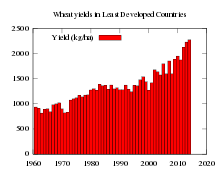
- Norman Borlaug fathered the Green Revolution, the set of research technology transfer initiatives occurring between 1950 and the belatedly 1960s that increased agricultural production in parts of the earth, beginning near markedly in the late 1960s, and is often credited with saving over a billion people worldwide from starvation.
Biology [edit]
- Genetics was unanimously accepted and significantly adult. The structure of DNA was determined in 1953 by James Watson,[41] [42] Francis Crick,[41] [42] Rosalind Franklin[42] and Maurice Wilkins,[41] [42] post-obit by developing techniques which allow to read DNA sequences and culminating in starting the Human Genome Project (not finished in the 20th century) and cloning the start mammal in 1996.
- The role of sexual reproduction in development was understood, and bacterial conjugation was discovered.
- The convergence of various sciences for the formulation of the mod evolutionary synthesis (produced betwixt 1936 and 1947), providing a widely accepted account of evolution.
Medicine [edit]
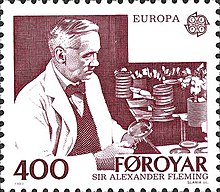
A stamp commemorating Alexander Fleming. His discovery of penicillin had inverse the world of modern medicine by introducing the age of antibiotics.
- Placebo-controlled, randomized, blinded clinical trials became a powerful tool for testing new medicines.
- Antibiotics drastically reduced mortality from bacterial diseases and their prevalence.
- A vaccine was developed for polio, catastrophe a worldwide epidemic. Effective vaccines were also adult for a number of other serious infectious diseases, including influenza, diphtheria, pertussis (whooping coughing), tetanus, measles, mumps, rubella (German measles), chickenpox, hepatitis A, and hepatitis B.
- Epidemiology and vaccination led to the eradication of the smallpox virus in humans.
- X-rays became powerful diagnostic tool for wide spectrum of diseases, from bone fractures to cancer. In the 1960s, computerized tomography was invented. Other of import diagnostic tools developed were sonography and magnetic resonance imaging.
- Development of vitamins virtually eliminated scurvy and other vitamin-deficiency diseases from industrialized societies.
- New psychiatric drugs were developed. These include antipsychotics for treating hallucinations and delusions, and antidepressants for treating depression.
- The role of tobacco smoking in the causation of cancer and other diseases was proven during the 1950s (see British Doctors Study).
- New methods for cancer handling, including chemotherapy, radiation therapy, and immunotherapy, were adult. Every bit a effect, cancer could often be cured or placed in remission.
- The development of blood typing and blood cyberbanking fabricated blood transfusion condom and widely available.
- The invention and development of immunosuppressive drugs and tissue typing made organ and tissue transplantation a clinical reality.
- New methods for heart surgery were developed, including pacemakers and bogus hearts.
- Cocaine and heroin were widely illegalized after being constitute to be addictive and destructive. Psychoactive drugs such as LSD and MDMA were discovered and subsequently prohibited in many countries. Prohibition of drugs caused a growth in the black market drug industry, and expanded enforcement led to a larger prison population in some countries.[43]
- Contraceptive drugs were developed, which reduced population growth rates in industrialized countries, likewise every bit decreased the taboo of premarital sexual practice throughout many western countries.
- The development of medical insulin during the 1920s helped raise the life expectancy of diabetics to 3 times of what it had been earlier.
- Vaccines, hygiene and clean water improved wellness and decreased bloodshed rates, especially amidst infants and the immature.
Notable diseases [edit]
- An flu pandemic, Spanish Flu, killed anywhere from 17 to 100 million people between 1918 and 1919.
- A new viral affliction, called the Human Immunodeficiency Virus, or HIV, arose in Africa and subsequently killed millions of people throughout the world. HIV leads to a syndrome chosen Acquired Immunodeficiency Syndrome, or AIDS. Treatments for HIV remained inaccessible to many people living with AIDS and HIV in developing countries, and a cure has yet to be discovered.
- Because of increased life spans, the prevalence of cancer, Alzheimer's disease, Parkinson'southward disease, and other diseases of onetime age increased slightly.
- Sedentary lifestyles, due to labor-saving devices and technology, along with the increment in home amusement and technology such as telly, video games, and the internet contributed to an "epidemic" of obesity, at first in the rich countries, simply past the terminate of the 20th century spreading to the developing world.
Energy and the environment [edit]

Oil field in California, 1938. The first modern oil well was drilled in 1848 by Russian engineer F.Northward. Semyonov, on the Apsheron Peninsula north-e of Baku.
- The dominant use of fossil sources and nuclear power, considered the conventional energy sources.
- Widespread utilise of petroleum in industry—both as a chemical precursor to plastics and every bit a fuel for the automobile and airplane—led to the geopolitical importance of petroleum resources. The Center East, home to many of the world'southward oil deposits, became a center of geopolitical and military tension throughout the latter half of the century. (For example, oil was a gene in Japan's decision to go to state of war confronting the United states of america in 1941, and the oil dare, OPEC, used an oil embargo of sorts in the wake of the Yom Kippur War in the 1970s).
- The increment in fossil fuel consumption also fueled a major scientific controversy over its effect on air pollution, global warming, and global climatic change.
- Pesticides, herbicides and other toxic chemicals accumulated in the environment, including in the bodies of humans and other animals.
- Population growth and worldwide deforestation diminished the quality of the environment.
- In the last third of the century, concern about humankind's touch on on the Earth'southward surroundings made environmentalism popular. In many countries, especially in Europe, the movement was channeled into politics through Green parties. Increasing awareness of global warming began in the 1980s, commencing decades of social and political contend.
Engineering and technology [edit]
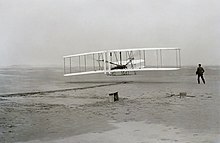
Start flying of the Wright Flyer, December 17, 1903, Orville piloting, Wilbur running at wingtip.
One of the prominent traits of the 20th century was the dramatic growth of engineering science. Organized research and do of science led to advocacy in the fields of communication, electronics, technology, travel, medicine, and state of war.
- Basic home appliances including washing machines, apparel dryers, furnaces, exercise machines, refrigerators, freezers, electric stoves and vacuum cleaners became popular from the 1920s through the 1950s. Radios were popularized equally a form of entertainment during the 1920s, which extended to tv during the 1950s.
- The first airplane, the Wright Flyer, was flown in 1903. With the engineering of the faster jet engine in the 1940s, mass air travel became commercially viable.
- The assembly line fabricated mass product of the automobile viable. By the end of the 20th century, billions of people had automobiles for personal transportation. The combination of the automobile, motor boats and air travel allowed for unprecedented personal mobility. In western nations, motor vehicle accidents became the greatest cause of death for immature people. Notwithstanding, expansion of divided highways reduced the death rate.
- The triode tube was invented.
- New materials, about notably stainless steel, Velcro, silicone, teflon, and plastics such every bit polystyrene, PVC, polyethylene, and nylon came into widespread utilize for many various applications. These materials typically have tremendous performance gains in force, temperature, chemic resistance, or mechanical properties over those known prior to the 20th century.
- Aluminum became an inexpensive metal and became second merely to iron in use.
- Thousands of chemicals were developed for industrial processing and habitation use.
Space exploration [edit]

American Fizz Aldrin during the offset moonwalk in 1969. The relatively young aerospace engineering industries rapidly grew in the 66 years after the Wright brothers' first flight.
- The Space Race between the Usa and the Soviet Marriage gave a peaceful outlet to the political and military tensions of the Cold War, leading to the first human spaceflight with the Soviet Matrimony's Vostok ane mission in 1961, and man'due south kickoff landing on another world—the Moon—with America'due south Apollo xi mission in 1969. Afterward, the offset space station was launched by the Soviet space plan. The Us developed the get-go reusable spacecraft system with the Infinite Shuttle programme, first launched in 1981. Equally the century ended, a permanent manned presence in infinite was being founded with the ongoing construction of the International Infinite Station.
- In addition to human spaceflight, unmanned space probes became a practical and relatively inexpensive class of exploration. The outset orbiting infinite probe, Sputnik 1, was launched by the Soviet Union in 1957. Over time, a massive system of artificial satellites was placed into orbit around World. These satellites greatly advanced navigation, communications, military machine intelligence, geology, climate, and numerous other fields. Also, past the end of the 20th century, unmanned probes had visited the Moon, Mercury, Venus, Mars, Jupiter, Saturn, Uranus, Neptune, and various asteroids and comets. The Hubble Space Telescope, launched in 1990, profoundly expanded our understanding of the Universe and brought vivid images to TV and computer screens effectually the world.
- The Global Positioning System, a serial of satellites that allow land-based receivers to make up one's mind their exact location, was developed and deployed.[44]
Digital revolution [edit]
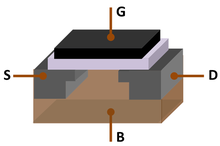
A technological revolution began in the late 20th century, variously chosen the Digital Revolution, the data revolution,[45] [46] [47] the electronics revolution,[48] the microelectronic revolution,[49] the Information Age,[l] the silicon revolution,[51] [52] the Silicon Age,[51] [52] [53] and/or the third industrial revolution.[54]
- The commencement transistor was invented past John Bardeen and Walter Houser Brattain at Bell Labs in 1947.[fifty] Still, early junction transistors were relatively bulky devices that were difficult to industry on a mass-production basis, which limited them to a number of specialised applications.[55]
- The MOSFET (metal-oxide-silicon field-effect transistor), also known as the MOS transistor, was invented by Mohamed K. Atalla and Dawon Kahng at Bell Labs,[56] [57] [58] [45] in November 1959.[59] It was the offset truly meaty transistor that could be miniaturised and mass-produced for a wide range of uses.[55] The widespread adoption of MOSFETs revolutionized the electronics industry,[60] condign the key edifice block of the Digital Revolution[61] [45] and "the base technology" of the late 20th to early on 21st centuries.[45] The MOSFET went on to go the most widely manufactured device in history.[62] [63]
- Semiconductor materials were discovered, and methods of production and purification developed for use in electronic devices. Silicon became i of the purest substances ever produced. The wide adoption of the MOSFET led to silicon becoming the dominant manufacturing textile during the late 20th century to early on 21st century,[51] [52] a menses that has been called the Silicon Age,[51] [52] [53] similar to how the Rock Age, Bronze Age and Fe Age were defined past the dominant materials during their respective ages of civilization.[51]
- The MOS integrated circuit chip (a silicon integrated circuit flake congenital from MOSFETs) revolutionized electronics and computers. The MOS chip was invented in the early 1960s.[64] The silicon-gate MOS chip later developed past Federico Faggin in 1968 was the basis for the starting time single-chip microprocessor, the Intel 4004, in 1971.[65] MOS integrated circuits and microprocessors led to the microcomputer revolution,[66] the proliferation of the personal computer in the 1980s, and so jail cell phones and the public-use Internet in the 1990s.
- Metallic-oxide-semiconductor (MOS) image sensors, which outset began appearing in the late 1960s, led to the transition from analog to digital imaging, and from analog to digital cameras, during the 1980s–1990s.[67] [68]
- Discrete cosine transform (DCT) coding, a information compression technique first proposed in 1972,[69] enabled practical digital media transmission in the 1990s,[seventy] [71] [72] with image compression formats such as JPEG (1992), video coding formats such as H.26x (1988 onwards) and MPEG (1993 onwards),[73] audio coding standards such as Dolby Digital (1991)[74] [75] and MP3 (1994),[73] and digital television standards such as video-on-demand (VOD)[seventy] and high-definition television (HDTV).[76]
- The number and types of abode appliances increased dramatically due to advancements in technology, the wide adoption of MOSFETs, electricity availability, the transition from analog to digital media, and increases in wealth and leisure time. The microwave oven became popular during the 1980s and take become a standard in all homes by the 1990s. Cablevision and satellite television spread rapidly during the 1980s and 1990s. Personal computers began to enter the domicile during the 1970s–1980s as well.
- Video games were popularized during the late 1970s to 1980s, with the gold age of arcade video games.
- The age of the portable music player was enabled by the development of the transistor radio, 8-track and cassette tapes in the 1960s, which slowly began to replace record players, culminating in the Sony Walkman in the tardily 1970s. These were in turn replaced by the digital compact disc (CD) during the 1980s to 1990s. The proliferation of the MDCT-based MP3 audio coding format[73] on the Cyberspace during the mid-to-late 1990s made digital distribution of music possible.
- Video cassette recorders (VCRs) were popularized in the 1970s, but by the end of the 20th century, DVD players were beginning to supersede them, making the VHS obsolete by the finish of the first decade of the 21st century.
- In that location was a rapid growth of the telecommunications manufacture towards the stop of the 20th century, driven by the development of large-calibration integration (LSI) complementary MOS (CMOS) technology, data theory, digital signal processing, and wireless communications such as cellular networks and mobile telephony.[77]
Religion [edit]
- The Vatican Ii council was held from 1962 to 1965, and resulted in significant changes in the Catholic Church building.
- The Wahhabi sect of Sunni Islam gained in influence with the growth of Kingdom of saudi arabia.
- Multiple new religions were founded, including the Nation of Islam, Scientology, and the Pentecostalism move.
- Disbelief became considerably more common, both in secular Western countries, and Communist countries with a policy of country atheism.
Economics [edit]
- The Slap-up Depression was a worldwide economic slowdown that lasted throughout the early 1930s.
- The Soviet Wedlock implemented a serial of five-year plans for industrialization and economical development.
- Most countries abandoned the gilded standard for their currency. The Bretton Woods organisation involved currencies being pegged to the United States dollar; afterwards the system collapsed in 1971 most major currencies had a floating substitution rate.
See also [edit]
- 20th-century inventions
- Expiry rates in the 20th century
- Infectious disease in the 20th century
- Modern art
- Short twentieth century
- Timelines of modernistic history
- List of 20th-century women artists
- List of notable 20th-century writers
- List of 20th-century American writers past birth year
- List of battles 1901–2000
- Listing of stories set in a future at present past
References [edit]
- ^ a b "Twentieth Century's Triumphant Entry". The New York Times. Jan 1, 1901. p. ane. Retrieved 2021-01-03 .
- ^ Wilson, East.O., The Future of Life (2002) (ISBN 0-679-76811-4). Come across also: Leakey, Richard, The Sixth Extinction : Patterns of Life and the Future of Humankind, ISBN 0-385-46809-1
- ^ "The Sixth Extinction – The Most Recent Extinctions". Archived from the original on 2015-12-xviii.
- ^ Johnston, Louis; Williamson, Samuel H. (2022). "What Was the U.S. GDP So?". MeasuringWorth . Retrieved February 12, 2022. United states Gross domestic product deflator figures follow the Measuring Worth serial.
- ^ "World Population to Hit Milestone With Birth of vii Billionth Person". PBS NewsHour. 27 October 2011. Retrieved 11 Feb 2018.
- ^ "World population hits half dozen billion". NBC News. four March 2004. Retrieved 11 February 2018.
- ^ https://www.youtube.com/watch?v=PUwmA3Q0_OE&t=5s American Museum of Natural History – Human Population Through Time
- ^ "Religions and babies | Hans Rosling" – via www.youtube.com.
- ^ "Commemorating Smallpox Eradication – a legacy of promise, for COVID-19 and other diseases". Globe Wellness Organization. 2020-05-08. Archived from the original on 2022-01-15.
- ^ Kritz, Fran (2019-09-19). "Russian Lab Explosion Raises Question: Should Smallpox Virus Be Kept Or Destroyed?". NPR . Retrieved 2022-01-15 .
- ^ "Quiz: Population 7 Billion – Could Nosotros All Fit in One City?". thirty October 2011. Retrieved 11 February 2018.
- ^ "The 21st Century and the 3rd Millennium When Did They Begin?". U.s.a. Naval Observatory. Archived from the original on 2019-10-02. Retrieved 2013-06-07 .
- ^ Pinker, Stephen (2011). The Better Angels of Our Nature. Viking. ISBN978-0-670-02295-3.
- ^ Marking Harrison (2002). Accounting for War: Soviet Product, Employment, and the Defence Burden, 1940–1945. Cambridge University Press. p. 167. ISBN 0-521-89424-7
- ^ Ferguson, Niall (2004). Empire: The ascent and demise of the British world social club and the lessons for global power. New York: Basic Books. ISBN978-0-465-02328-viii.
- ^ Fleegler, Robert 50. Theodore G. Bilbo and the Reject of Public Racism, 1938–1947 Archived 2009-02-06 at the Wayback Auto. Retrieved 23 December 2014
- ^ Zadey, Siddhesh (2019-11-25). "Constitution Mean solar day: Do We Truly Know the 'Real' Ambedkar?". TheQuint . Retrieved 2021-07-30 .
- ^ "Ambedkar and political reservation". The Indian Express. 2020-08-16. Retrieved 2021-07-30 .
- ^ Smith, J.B.; et al. "Ch. xix. Vulnerability to Climatic change and Reasons for Concern: A Synthesis". Farthermost and Irreversible Effects. Sec 19.six. Archived from the original on 2016-ten-xviii. Retrieved 2014-07-10 . , in IPCC TAR WG2 2001
- ^ IPCC AR5 WG1 2013, "Summary for Policymakers, Observed Changes in the Climate Organization", pp. 10–11: "Total radiative forcing is positive, and has led to an uptake of energy by the climate system. The largest contribution to total radiative forcing is caused past the increase in the atmospheric concentration of CO2 since 1750." (p eleven). "From 1750 to 2011, CO2 emissions from fossil fuel combustion and cement product take released 375 [345 to 405] GtC to the temper, while deforestation and other land use change are estimated to have released 180 [100 to 260] GtC." (p. 10).
- ^ "World Population: Historical Estimates of World Population". United States Census Agency. December 19, 2013. Retrieved 2015-01-09 .
- ^ "World Population: Full Midyear Population for the World: 1950–2050". United States Census Bureau. December nineteen, 2013. Retrieved 2015-01-09 .
- ^ Democide See diverse exclusions
- ^ Charles Tilly (2003). "The politics of collective violence" Cambridge University Press. p. 55. ISBN 0-521-53145-4.
- ^ Gary Rodger Weaver (1998). Culture, Communication, and Conflict. Simon & Schuster. p. 474. ISBN 0-536-00373-4
- ^ Suny 2015, pp. 245, 330.
- ^ Bozarslan, Duclert & Kévorkian 2015, p. 187.
- ^ Prominent among this group was the late Tony Judt.
- ^ Geoffrey A. Hosking (2001). "Russian federation and the Russians: a history". Harvard University Press. p. 469. ISBN 0-674-00473-6
- ^ "The Other Killing Machine". The New York Times. May 11, 2003
- ^ a b "China's smashing famine: 40 years afterwards". British Medical Journal 1999;319:1619–1621 (December 18 )
- ^ Thee, Marek (1976). "The Indochina Wars: Bully Power Involvement – Escalation and Detachment". Journal of Peace Research. Sage Publications. 13 (two): 117–129. doi:x.1177/002234337601300204. ISSN 1460-3578. JSTOR 423343. S2CID 110243986.
- ^ "You saw it hither outset: Pittsburgh's Nickelodeon introduced the flick theater to the masses in 1905". Pittsburgh Post-Gazette. xviii June 2005. Retrieved xi February 2018.
- ^ Jason Whittaker (2004), The cyberspace handbook, Routledge, p. 122, ISBN978-0-415-16835-9
- ^ Coates, James (May eighteen, 1993). "How Mario Conquered America". Chicago Tribune. Archived from the original on November 23, 2015. Retrieved February 7, 2018.
- ^ "PlayStation 2 Breaks Record as the Fastest Estimator Entertainment Platform to Reach Cumulative Shipment of 100 One thousand thousand Units" (PDF) (Printing release). Sony Computer Entertainment. 30 November 2005. Archived from the original (PDF) on three January 2006. Retrieved 8 June 2008.
- ^ Boyer, Carl B. (1991). A history of mathematics. Merzbach, Uta C., 1933–, Rogers D. Spotswood Collection. (2nd ed. [rev.] ed.). New York: Wiley. ISBN978-0471543978. OCLC 23823042.
- ^ Devaney, Robert 50. (1998). A first grade in cluttered dynamical systems : theory and experiment (vi. printing. ed.). Reading, Mass. [u.a.]: Addison-Wesley. ISBN978-0-201-55406-9.
- ^ Kenneth Appel; Wolfgang Haken (26 July 1976). "Every Planar Map is 4-Colorable". Bulletin of the American Mathematical Lodge. Contemporary Mathematics. 98. doi:10.1090/conm/098. ISBN9780821851036. S2CID 8735627.
- ^ Thomson, Sir William (1862). "On the Age of the Sun's Heat". Macmillan'south Magazine. 5: 288–293.
- ^ a b c "The Nobel Prize in Physiology or Medicine 1962". NobelPrize.org. Nobel Media AB. Retrieved November five, 2011.
- ^ a b c d "James Watson, Francis Crick, Maurice Wilkins, and Rosalind Franklin". Science History Constitute. June 2016. Archived from the original on 21 March 2018. Retrieved twenty March 2018.
- ^ Engel, Pamela (Apr 23, 2014). "Spotter How Quickly The State of war On Drugs Changed America's Prison Population". Business concern Insider.
- ^ "Global Positioning System History". 2012-x-27. Retrieved 2018-02-07 .
- ^ a b c d "Triumph of the MOS Transistor". YouTube. Computer History Museum. 6 Baronial 2010. Archived from the original on 2021-10-29. Retrieved 21 July 2019.
- ^ Raymer, Michael G. (2009). The Silicon Web: Physics for the Internet Age. CRC Press. p. 365. ISBN9781439803127.
- ^ Wong, Kit Po (2009). Electrical Engineering – Volume II. EOLSS Publications. p. 7. ISBN9781905839780.
- ^ Williams, J. B. (2017). The Electronics Revolution: Inventing the Hereafter. Springer. ISBN9783319490885.
- ^ Zimbovskaya, Natalya A. (2013). Transport Backdrop of Molecular Junctions. Springer. p. 231. ISBN9781461480112.
- ^ a b Manuel, Castells (1996). The information age : economic system, society and culture. Oxford: Blackwell. ISBN978-0631215943. OCLC 43092627.
- ^ a b c d e Feldman, Leonard C. (2001). "Introduction". Fundamental Aspects of Silicon Oxidation. Springer Scientific discipline & Business Media. pp. 1–11. ISBN9783540416821.
- ^ a b c d Dabrowski, Jarek; Müssig, Hans-Joachim (2000). "1.2. The Silicon Age". Silicon Surfaces and Formation of Interfaces: Basic Science in the Industrial World. World Scientific. pp. three–thirteen. ISBN9789810232863.
- ^ a b Siffert, Paul; Krimmel, Eberhard (2013). "Preface". Silicon: Evolution and Futurity of a Technology. Springer Scientific discipline & Business Media. ISBN9783662098974.
- ^ Chapuis, Robert J.; Joel, Amos E. (2003). 100 Years of Telephone Switching. IOS Printing. pp. 148–49. ISBN9781586033729.
- ^ a b Moskowitz, Sanford L. (2016). Advanced Materials Innovation: Managing Global Technology in the 21st century. John Wiley & Sons. p. 168. ISBN9780470508923.
- ^ "1960 – Metallic Oxide Semiconductor (MOS) Transistor Demonstrated". The Silicon Engine. Figurer History Museum.
- ^ Lojek, Bo (2007). History of Semiconductor Engineering . Springer Science & Business Media. pp. 321–323. ISBN9783540342588.
- ^ "Who Invented the Transistor?". Computer History Museum. 4 December 2013. Retrieved 20 July 2019.
- ^ Bassett, Ross Knox (2007). To the Digital Age: Research Labs, Commencement-upwards Companies, and the Rise of MOS Engineering science. Johns Hopkins University Printing. p. 22. ISBN9780801886393.
- ^ Chan, Yi-Jen (1992). Studies of InAIAs/InGaAs and GaInP/GaAs heterostructure FET'southward for high speed applications. University of Michigan. p. 1.
The Si MOSFET has revolutionized the electronics industry and as a outcome impacts our daily lives in almost every conceivable way.
- ^ Wong, Kit Po (2009). Electric Technology – Volume Ii. EOLSS Publications. p. seven. ISBN978-1905839780.
- ^ "13 Sextillion & Counting: The Long & Winding Route to the Most Oftentimes Manufactured Human Antiquity in History". Computer History Museum. April ii, 2018. Retrieved 28 July 2019.
- ^ Baker, R. Jacob (2011). CMOS: Circuit Design, Layout, and Simulation. John Wiley & Sons. p. seven. ISBN978-1118038239.
- ^ Shirriff, Ken (thirty August 2016). "The Surprising Story of the First Microprocessors". IEEE Spectrum. Constitute of Electrical and Electronics Engineers. 53 (9): 48–54. doi:10.1109/MSPEC.2016.7551353. S2CID 32003640. Retrieved thirteen October 2019.
- ^ "1971: Microprocessor Integrates CPU Function onto a Unmarried Chip | The Silicon Engine". Computer History Museum . Retrieved 22 July 2019.
- ^ Malmstadt, Howard V.; Enke, Christie One thousand.; Crouch, Stanley R. (1994). Making the Right Connections: Microcomputers and Electronic Instrumentation. American Chemical Society. p. 389. ISBN9780841228610.
The relative simplicity and low power requirements of MOSFETs have fostered today'south microcomputer revolution.
- ^ Williams, J. B. (2017). The Electronics Revolution: Inventing the Future. Springer. pp. 245–8. ISBN9783319490885.
- ^ Fossum, Eric R. (12 July 1993). Blouke, Morley M. (ed.). "Agile pixel sensors: are CCDs dinosaurs?". SPIE Proceedings Vol. 1900: Charge-Coupled Devices and Solid State Optical Sensors III. International Club for Optics and Photonics. 1900: 2–14. Bibcode:1993SPIE.1900....2F. CiteSeerX10.one.1.408.6558. doi:ten.1117/12.148585. S2CID 10556755.
- ^ Ahmed, Nasir (January 1991). "How I Came Up With the Detached Cosine Transform". Digital Signal Processing. 1 (one): iv–5. doi:x.1016/1051-2004(91)90086-Z.
- ^ a b Lea, William (9 May 1994). Video on demand: Research Paper 94/68. House of Commons Library. Archived from the original on twenty September 2019. Retrieved twenty September 2019.
- ^ Frolov, Artem; Primechaev, S. (2006). "Compressed Domain Prototype Retrievals Based On DCT-Processing". Semantic Scholar. S2CID 4553.
- ^ Lee, Ruddy Bei-Loh; Beck, John P.; Lamb, Joel; Severson, Kenneth E. (April 1995). "Existent-time software MPEG video decoder on multimedia-enhanced PA 7100LC processors" (PDF). Hewlett-Packard Periodical. 46 (2). ISSN 0018-1153.
- ^ a b c Stanković, Radomir S.; Astola, Jaakko T. (2012). "Reminiscences of the Early Work in DCT: Interview with K.R. Rao" (PDF). Reprints from the Early Days of Information Sciences. 60 . Retrieved xiii Oct 2019.
- ^ Luo, Fa-Long (2008). Mobile Multimedia Dissemination Standards: Engineering and Practice. Springer Science & Business Media. p. 590. ISBN9780387782638.
- ^ Britanak, Five. (2011). "On Backdrop, Relations, and Simplified Implementation of Filter Banks in the Dolby Digital (Plus) Air-conditioning-three Audio Coding Standards". IEEE Transactions on Audio, Speech, and Language Processing. 19 (v): 1231–1241. doi:10.1109/TASL.2010.2087755. S2CID 897622.
- ^ Shishikui, Yoshiaki; Nakanishi, Hiroshi; Imaizumi, Hiroyuki (October 26–28, 1993). "An HDTV Coding Scheme using Adaptive-Dimension DCT". Signal Processing of HDTV: Proceedings of the International Workshop on HDTV '93, Ottawa, Canada. Elsevier: 611–618. doi:10.1016/B978-0-444-81844-7.50072-3. ISBN9781483298511.
- ^ Srivastava, Viranjay M.; Singh, Ghanshyam (2013). MOSFET Technologies for Double-Pole Four-Throw Radio-Frequency Switch. Springer Scientific discipline & Concern Media. p. 1. ISBN9783319011653.
Sources [edit]
- IPCC AR5 WG1 (2013), Stocker, T.F.; et al. (eds.), Climatic change 2013: The Physical Science Ground. Working Group ane (WG1) Contribution to the Intergovernmental Console on Climate change (IPCC) 5th Assessment Report (AR5), Cambridge University Printing . Climatic change 2013 Working Group 1 website.
- IPCC TAR WG2 (2001). McCarthy, J. J.; Canziani, O. F.; Leary, N. A.; Dokken, D. J.; White, K. S. (eds.). Climate change 2001: Impacts, Adaptation and Vulnerability. Contribution of Working Grouping Ii to the Third Assessment Report of the Intergovernmental Panel on Climatic change. Cambridge University Press. ISBN978-0521807685. Archived from the original on fourteen May 2016. Retrieved eighteen December 2019. (lead: 0521015006)
- Bozarslan, Hamit; Duclert, Vincent; Kévorkian, Raymond H. (2015). Comprendre le génocide des arméniens—1915 à nos jours [Agreement the Armenian genocide: 1915 to the present day] (in French). Tallandier. ISBN979-10-210-0681-two.
- Suny, Ronald Grigor (2015). "They Can Live in the Desert merely Nowhere Else": A History of the Armenian Genocide. Princeton Academy Press. ISBN978-1-4008-6558-1.
Farther reading [edit]
- Brower, Daniel R. and Thomas Sanders. The World in the Twentieth Century (seventh Ed, 2013)
- CBS News. People of the century. Simon and Schuster, 1999. ISBN 0-684-87093-2
- Grenville, J. A. Due south. A History of the Globe in the Twentieth Century (1994). online free
- Hallock, Stephanie A. The World in the 20th Century: A Thematic Approach (2012)
- Langer, William. An Encyclopedia of Earth History (5th ed. 1973); highly detailed outline of events online free
- Morris, Richard B. and Graham Due west. Irwin, eds. Harper Encyclopedia of the Modern Globe: A Concise Reference History from 1760 to the Nowadays (1970) online
- Pindyck, Robert S. "What we know and don't know about climatic change, and implications for policy." Environmental and Energy Policy and the Economy 2.ane (2021): 4-43. online
- Pollard, Sidney, ed. Wealth and Poverty: an Economical History of the 20th Century (1990), 260 pp; global perspective online free
- Stearns, Peter, ed. The Encyclopedia of World History (2001)
- UNESCO (February 28, 2008). "The Twentieth Century". History of Humanity. Vol. Vii. Routledge. p. 600. ISBN978-0-415-09311-viii.
External links [edit]
Source: https://en.wikipedia.org/wiki/20th_century
0 Response to "Which of the Following Is Not an Art Movement From the Early 20th Century"
Post a Comment