what primary color must be added to magenta light to produce white light?
Start Things First: How We Run across Color
The inner surfaces of your eyes incorporate photoreceptors—specialized cells that are sensitive to light and relay messages to your brain. There are two types of photoreceptors: cones (which are sensitive to color) and rods (which are more sensitive to intensity). You are able to "see" an object when calorie-free from the object enters your optics and strikes these photoreceptors.
Some objects are luminous and give off their ain low-cal; all other objects can only be seen if they reflect light into your eyes. However, humans tin only see visible calorie-free, a narrow band of the electromagnetic spectrum (which likewise includes not-visible radio waves, infrared light, ultraviolet light, X-rays, and gamma rays). In terms of wavelengths, visible light ranges from about 400 nm to 700 nm.
Different wavelengths of light are perceived equally different colors. For case, light with a wavelength of most 400 nm is seen equally violet, and light with a wavelength of well-nigh 700 nm is seen every bit red. Even so, it is not typical to see light of a single wavelength. You are able to perceive all colors because there are three sets of cones in your eyes—one set that is nearly sensitive to reddish calorie-free, another that is most sensitive to light-green light, and a third that is most sensitive to blue lite.
Source: Harvard—Smithsonian Center for Astrophysics
This media asset was adjusted from Shedding Light on Science
Primary Colors
This is where color can go a little disruptive for some folks. There are two basic color models that art and pattern students need to learn in order to take an expert command over color, whether doing impress publications in graphic design or combining pigment for press. These two color models are:
- Light Colour Primaries (Red, Green, Blueish)
- Pigment Color Primaries (Cyan, Magenta, Yellow)
Some of you might exist scratching your heads, asking, "Where is the Blue, Ruddy, and Yellowish model?" The artist colour wheel (based in blueish, red, and yellow) predates mod scientific discipline and was discovered by Newton's prism experiments. Scientifically, this does not fairly address the truthful range of spectral colour. Upon discovering more about spectral color and how wavelengths work with surfaces (reflection/assimilation) and the human eye, the blue-ruddy-yellow model is shifting to the cyan-magenta-yellowish model. We Do, however, still employ the RBY model for mixing paints, and it is the about mutual color wheel students volition typically observe in art stores.
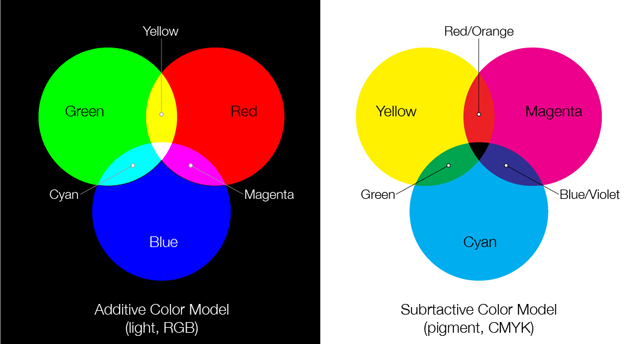
Additive (Calorie-free) Color Primaries
Ruddy, dark-green, and blue are the primary colors of light —they can exist combined in unlike proportions to make all other colors. For example, ruby light and dark-green low-cal added together are seen as yellow low-cal. This additive color system is used by lite sources, such every bit televisions and computer monitors, to create a broad range of colors. When different proportions of cherry-red, light-green, and blue calorie-free enter your eye, your brain is able to interpret the different combinations as unlike colors.
Source: Harvard—Smithsonian Eye for Astrophysics
This media nugget was adapted from Shedding Light on Science
Additive (Lite) Cheat Canvass
- Color is transmitted through transparent media.
- All colors added together = white.
- The absence of light = true black.
- Because computer graphics, websites, and other digital presentations are projected/transmitted with low-cal, screen-targeted graphics should be saved in this color model, or "RGB Mode."
- Of import: Note that when RGB'due south primaries are mixed evenly that they create the secondary colors of our next color model, CMY (cyan, magenta, and yellow)!
Subtractive (Pigment) Color Primaries
Yet, in that location is some other set of primary colors with which you may exist more familiar. The primary colors of pigment (also known as subtractive primaries) are used when producing colors from reflected light; for example, when mixing pigment or using a color printer. The chief colors of pigment are magenta, xanthous, and cyan (usually simplified every bit red, xanthous, and blue).
Pigments are chemicals that absorb selective wavelengths —they foreclose certain wavelengths of lite from beingness transmitted or reflected. Considering paints incorporate pigments, when white light (which is equanimous of red, greenish, and bluish low-cal) shines on colored paint, simply some of the wavelengths of light are reflected. For example, cyan pigment absorbs red low-cal but reflects blue and dark-green calorie-free; xanthous paint absorbs blue light but reflects red and greenish calorie-free. If cyan paint is mixed with yellow paint, you run across greenish pigment because both carmine and blue light are absorbed and merely green light is reflected.
Source: Harvard—Smithsonian Heart for Astrophysics
This media nugget was adapted from Shedding Light on Science
Subtractive (Pigment) Cheat Sail
- These primaries are ultimately derived from the RGB model as secondary colors. The chief reason they are promoted to having their own color model is because information technology is from CMY that we tin create all other printable colors. Remember that, ultimately, without the existence of RGB light wavelengths, nosotros would come across aught.
- Colour is absorbed by and reflected off of media.
- Because these colors are achieved via reflection, we assume a pure white basis as the base filter for pure colors.
- All colors added together = almost black.
- To accomplish true black, pure blackness must be added, thus giving us the CMYK model (K=blackness). This is the standard colour model for nearly printing, thus graphics for print are typically prepared in "CMYK Fashion."
- While most printers recognize this model every bit the standard pigment model, the traditional artist Color Wheel substitutes Blue every bit the Cyan primary and Blood-red as the Magenta primary, resulting in slightly different secondary and tertiary results.
NOTICE: The colors in RGB appear slightly more brilliant than in CMYK. This can be attributed to the difference between the mode of transmitting light vs. absorbing/reflecting light off of surfaces.
Spotter This Demo For a Ameliorate Understanding
>>>>>> Demo on Light and Pigment Primaries <<<<<<
Extra:
***Download the PDF diagram and explanation of the Additive and Subtractive Color Models here.
Next Lesson >>
Source: https://learn.leighcotnoir.com/artspeak/elements-color/primary-colors/
0 Response to "what primary color must be added to magenta light to produce white light?"
Post a Comment