The Pharaoh Who Changed the Style of Egyptian Art Was
Of all the pharaohs who ruled aboriginal Egypt, there is one in particular that stands out from the rest. Over the form of his 17-yr reign (1353-1336 BCE), Akhenaten spearheaded a cultural, religious, and creative revolution that rattled the country, throwing thousands of years of tradition out the window and imposing a new world social club. After his death his name was omitted from the king lists, his images desecrated and destroyed. From the surviving fragments of prove, Egyptologists have pieced together the story of his life and reign, a period of spiritual upheaval and experimentation unlike any other in Egyptian history. Under his supervision, Egyptian art underwent a monumental transformation, with centuries of rigid convention abandoned in favor of a new, highly stylized artistic arroyo imbued with divine meaning.

Statue of Akhenaten
Early on REIGN OF AMENHOTEP 4
The 2nd son of Pharaoh Amenhotep Iii, Akhenaten (originally Amenhotep Four) was never meant to be king. His elderberry brother, Prince Thutmose, was heir credible, merely later on his untimely demise, young Amenhotep plant himself thrust into the political spotlight. Post-obit a brief catamenia of co-regency, Amenhotep III died in 1353 BCE, and Amenhotep 4 ascended to the throne. With his Great Wife Nefertiti by his side, the new pharaoh began what appeared to exist a conventional reign: he dedicated monuments to Amun, added to the temple circuitous at Karnak, and even held a Sed festival in Regnal Year 3. However, Amenhotep IV'southward rule was annihilation but ordinary, and shortly the king began to let his true colors show. The pharaoh was a fanatical devotee of Aten, a deity representing the physical class of the sun deejay. Unlike virtually other Egyptian gods and goddesses, Aten had no homo characteristics and took no anthropomorphic form. Under Amenhotep's management, this fringe cult soon became the largest religious sect in Egypt.
In Regnal Year 5, the pharaoh dropped all pretense & declared Aten the official country deity of Egypt.
In Regnal Year 5, the pharaoh dropped all pretense and declared Aten the official state deity of Arab republic of egypt, directing focus and funding away from the Amun priesthood to the cult of the dominicus disk. He even changed his name from Amenhotep ('Amun is Satisfied') to Akhenaten ('Effective for the Aten,') and ordered the construction of a new upper-case letter city, Akhetaten ('The Horizon of Aten') in the desert. Located at the modern site of Tell el-Amarna, Akhetaten was situated between the ancient Egyptian cities of Thebes and Memphis on the east banking company of the Nile.
ARCHITECTURE OF THE AMARNA Menses
Not long after coming to ability, Akhenaten/Amenhotep IV commissioned the construction of a new temple complex side by side to the 1 at Karnak (modern-day Luxor). This new project, all the same, was a completely separate entity from the temple to Amun, fabricated clear by the fact that the site was located outside of Karnak's perimeter. Named Gempaaten ('The Aten is Constitute'), Amenhotep's new temple complex was unlike any that had come before it. Instead of being comprised of individual, airtight-in sanctuaries, the open up-air courtyards at Gempaaten allowed Aten'south sunlight to catamenia directly into the complex.

Smaller Aten Temple, Amarna
Following in the footsteps of Gempaaten, the Cracking Aten Temple in Amarna was another prime number example of an "open up-air" temple. Surrounded by a large enclosure wall, the temple complex consisted of ii primary structures: the Sanctuary, located in the eastern section of the complex, and the Long Temple, located in the western section. The fact that this temple was arranged on an eastward-w axis was itself a nod to the path that Aten took across the heaven each day. The Sanctuary was composed of two courts, the second of which was open up to the air and housed the chantry where Akhenaten and Nefertiti would nowadays their private offerings to the dominicus disk. The Long Temple consisted of a columned court and more 900 small-scale, open-air altars where priests would burn offerings to the Aten. Due north of the Great Aten Temple was a second, smaller temple, situated in the center of Amarna closer to the palace and king'south majestic residence. This second temple also followed the layout of Gempaaten and the Neat Aten Temple, synthetic then that it was exposed to direct sunlight at all times.
Amarna'south multiple palaces were constructed of mudbrick and painted with colorful, highly decorative scenes of plants, wild animals, and the royal family. These structures included many open courts and columned porticos, every bit well as big courtyards decorated with colossal stone statues of Akhenaten and Nefertiti.
PORTRAITURE OF AKHENATEN
Artifacts from Akhenaten's reign are instantly recognizable for their unique creative style. Among the nearly striking of these pieces are those depicting the king himself, many of which have lead Egyptologists to question the country of the pharaoh's health and concrete appearance. A prime example comes from Gempaaten: an enormous, full-body statue of Akhenaten exhibiting some peculiar characteristics. The rex'south face is long and thin, with slit optics and large, total lips. His figure is equally strange and out-of-proportion, with spindly artillery, long fingers, a paunch, and feminine hips and breasts. This particular statue is fragmentary, cut the pharaoh off at the knees, only from other depictions of Akhenaten that take survived, it tin can exist inferred that the pharaoh's legs tapered out from large thighs to thin calves ending in elongated feet. At first glance, such a statue is shocking, equally information technology strays so far from the path of typical Egyptian creative convention. Instead of presenting the image of a young, fit, virile rex, artistic representations of Akhenaten convey a very dissimilar message. With such foreign actual proportions and facial features, the pharaoh comes across as weak, sickly, and effeminate.
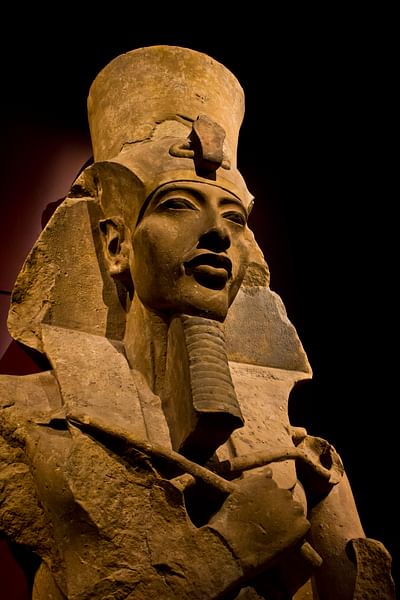
Colossal Statue of Amenhotep Four
Why did Akhenaten cull to exist presented to his subjects like this? As pharaoh, he had complete control over the product and distribution of artwork and, therefore, was certainly the driving forcefulness backside such assuming artistic choices. Statues similar the Gempaaten colossi take caused many historians to speculate about Akhenaten'southward life and the possibility of the pharaoh being afflicted past a genetic disorder. Generations of inbreeding and brother-sister marriages during the 18th Dynasty make this theory a very real possibility. Even so, most Egyptologists contend that Akhenaten'due south striking visage has more to practise with religious symbolism than capturing the male monarch's literal physical likeness.
Like many of his predecessors, Akhenaten believed himself to be a living god. While most Egyptian pharaohs aligned themselves with the gods of the traditional Egyptian pantheon such as Horus, Akhenaten fittingly decided to associate himself with Aten; one of the king's many epithets was 'The Dazzling Aten,' and he believed himself to be the sun disk's physical manifestation on world. Different other Egyptian deities, Aten was neuter; the sunday disk was a physical object with no discernable sex. It is reasonable to believe, therefore, that Akhenaten (a form of the deity itself) chose to describe himself in a similarly androgynous style. Historical and archaeological bear witness has clearly proven that Akhenaten was a fertile male (he had at least vi daughters and ane son), but the inclusion of such hitting female traits in artistic depictions of the king sent a powerful message, connecting the pharaoh to the essence of Aten itself.
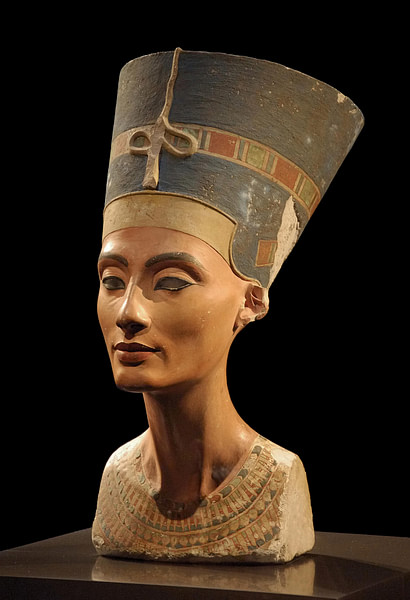
Queen Nefertiti
Over the form of Akhenaten's reign, it is known that at to the lowest degree two different sculptors were employed in the service of the rex. The outset, a man named Bak, is mainly credited with the earliest and most radical Amarna-style pieces (i.east. the Gempaaten colossi). It has been suggested the period immediately following Regnal Year five served as a sort of "experimentation period" in which Akhenaten tried to button the boundaries of Egyptian artistic convention as far equally he could, every bit a issue producing some of the almost radical and stylized pieces of the Amarna Flow. In the later years of Akhenaten'southward rule, Bak was replaced by another sculptor, Thutmose, who had a more than measured approach to his work. Items recovered from Thutmose's workshop show that the sculptor favored a more realistic, less-exaggerated manner than his predecessor, all-time exemplified past his iconic bust of Nefertiti on display in Berlin.
IMAGES OF NEFERTITI & THE Regal FAMILY
1 of the most touching and fascinating aspects of art during the Amarna Period is how Akhenaten and his family presented themselves. In traditional Egyptian artwork, the figures are usually quite stiff and equanimous, oftentimes depicted participating in solemn religious ceremonies or political events. Seldom were the royal family shown in a coincidental setting, spending time together in scenes from their daily life. During the reign of Akhenaten, all the same, all this inverse. The pharaoh was virtually always accompanied by his daughters, and his Bully Wife Nefertiti was e'er by his side. The family was ofttimes shown offer to the Aten, but in that location are also scenes of the majestic family unit eating together and relaxing in the palace. The young princesses were oftentimes captured playing around their parents' thrones, or cradled in their laps. Nefertiti (and her daughters) were also painted with the same ruddy ochre skin tone as her husband, a color typically reserved for males, and, along with the pharaoh, had unusually detailed hands and anxiety (before this point, the Egyptians had made no effort to distinguish between correct and left appendages).
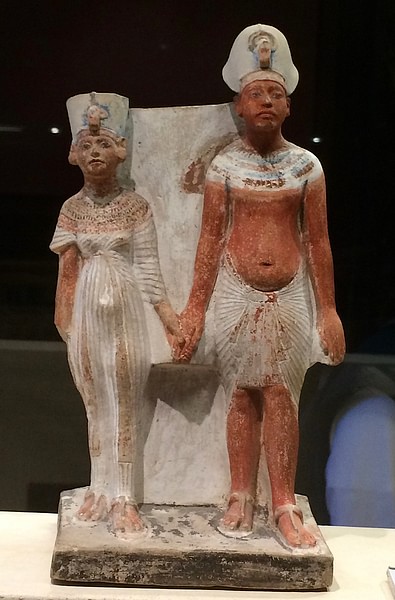
Akhenaten & Nefertiti
There be countless stelae and carvings of Akhenaten and Nefertiti doting on ane some other and property hands: in i case the queen even sits on her husband's lap. The couple also frequently appears in relief scenes showing them riding chariots together and bestowing gifts on their subject from the "Window of Appearances" in their Amarna palace. This kind of appreciating, realistically-casual portrayal of a pharaoh was unprecedented in Egyptian history.
Similarly unheard of was the symbolic precedence given to Queen Nefertiti in the art of the Amarna Catamenia. Instead of beingness portrayed every bit a scaled-down female effigy standing behind her married man, Nefertiti was often presented at the same scale as Akhenaten, a bold artistic choice denoting her corking importance and influence in courtroom. And of import she was: during the last few years of Akhenaten's reign, he appointed Nefertiti as his official co-regent, essentially making her a second king of Arab republic of egypt on completely equal footing with him.
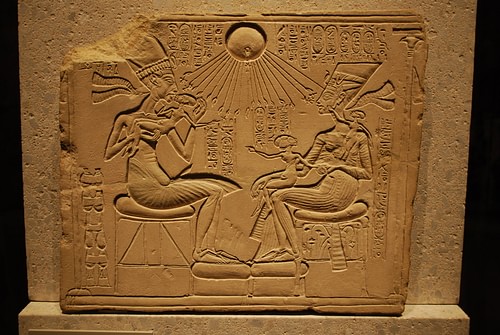
Akhenaten and the Royal Family Blessed by Aten
To further emphasize both her elevated position and the couple'south close relationship, early artistic depictions of Akhenaten and Nefertiti portray the king and queen every bit well-nigh identical figures. Only a few discrete markers existed to differentiate the two rulers, such equally crowns (Akhenaten favored the k hat headdress while Nefertiti favored a apartment-topped blueish crown), wig styles (variations of the cropped "Nubian-mode" wig were pop with both husband and married woman), and the length and/or manner of their garments. This bold choice was, again, spurred on by religious symbolism.
Past appearing as identical figures, Akhenaten and Nefertiti were aligning themselves with the twin deities Shu and Tefnut, respectively. Nefertiti's same flat-topped headdress was traditionally associated with the goddess Tefnut. Akhenaten clearly wanted to associate himself and his queen with these primordial creation deities, who, complementary to the Aten, represented forces of life and rebirth. The king and queen, in essence, became the "Father" and "Mother" of the globe and heavens, putting them in a divine triad with Aten. Just equally depictions of the pharaoh became more toned-down and realistic during the later years of his reign, the tendency of the male monarch and queen to appear as identical figures faded, although their divine association with the twin deities remained in place.
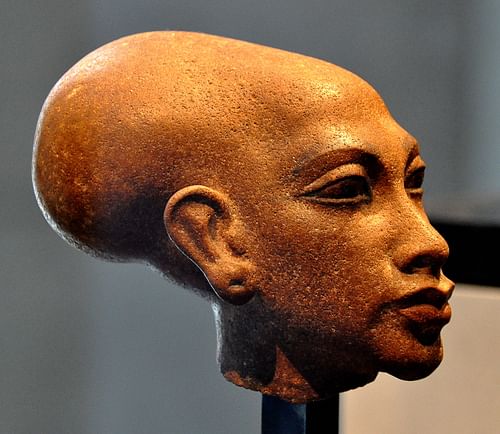
Girl of Akhenaten
When it comes to the private tombs and monuments of Amarna's not-royal inhabitants, images of the regal family play an interesting role. Where once there would accept been images of Horus, Amun, Isis, and other traditional deities lining the walls of elite burying chambers, at present stood images of Akhenaten, Nefertiti, and their children. Of course, images of Aten were always present, and the dominicus disk always took precedence over any human characters depicted alongside it. However, during the Amarna menstruation images of the royal family completely replaced images of the gods that had decorated Egyptian tombs for centuries. Fifty-fifty on the pharaoh'due south own stone sarcophagus, images of Nefertiti replaced those of traditional goddesses. Akhenaten, by associating himself with Shu and the Aten, and Nefertiti with Tefnut, had effectively presented himself and his family as living gods. What need was there, and then, for images of other deities on the walls of his subjects' tombs? The pharaoh, his queen, and their offspring were a sacred extension of Aten on world and therefore expected to exist worshipped in their own right and to human activity as intermediaries between Aten and the common homo.
THE END OF A DYNASTY
After 17 years on the throne, Pharaoh Akhenaten died in 1336 BCE. He was succeeded by the mysterious Smenkhkare (a brusque-lived pharaoh many Egyptologists believe to accept been Nefertiti), who in turn was succeeded past Akhenaten's young son Tutankhaten. Post-obit Akhenaten'south death, the Egyptian people were quick to voice their opposition to the "heretic" king'due south radical religious reforms. Favoring the stability of the quondam order, Tutankhaten moved the majuscule back to Memphis and reinstated the worship of Arab republic of egypt's polytheistic pantheon. Within a few years, Amarna, Akhenaten'south glorious 'Horizon of the Aten' had been completely abandoned, its male monarch and queen buried and forgotten. In a further attempt to distance himself from his male parent'due south legacy, the boy rex changed his name from Tutankhaten ('The Living Image of Aten') to Tutankhamun ('The Living Image of Amun'). His wife and half-sister, Ankhesenpaaten, also followed suit, rebranding herself as Ankhesenamun ('Her Life is of Amun').
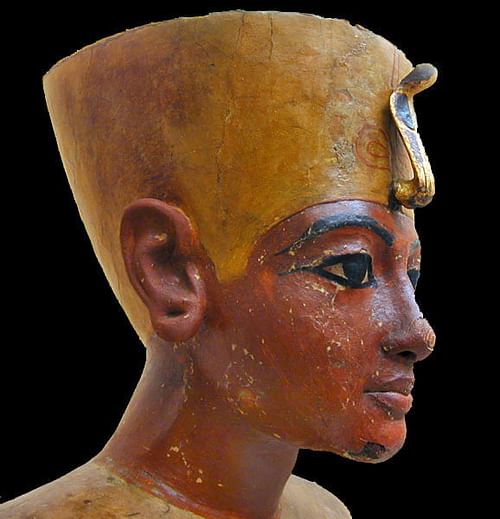
Tutankhamun
During his reign, Pharaoh Tutankhamun made great strides towards restoring Egypt to its pre-Amarna land, a campaign championed past the subsequent kings Ay and Horemheb. While Amarna-style art connected to exist produced during this transitional flow (especially evident in the murals decorating Tutankhamun's burial chamber), ultimately artistic tradition prevailed and Egyptian art from the 19th Dynasty and across largely adhered to historical conventions. With the death of Pharaoh Horemheb in 1292 BCE came the end of the 18th Dynasty itself: Horemheb'south heir Ramesses I would plant a new dynastic line, ushering Arab republic of egypt into a golden age of armed services might and economic prosperity. In less than fifty years, nearly every trace of Akhenaten, his controversial reign, and the artistic conventions that defined it had been wiped from existence.
This article has been reviewed for accuracy, reliability and adherence to academic standards prior to publication.
Source: https://www.worldhistory.org/article/1110/the-art-of-the-amarna-period/
0 Response to "The Pharaoh Who Changed the Style of Egyptian Art Was"
Post a Comment